

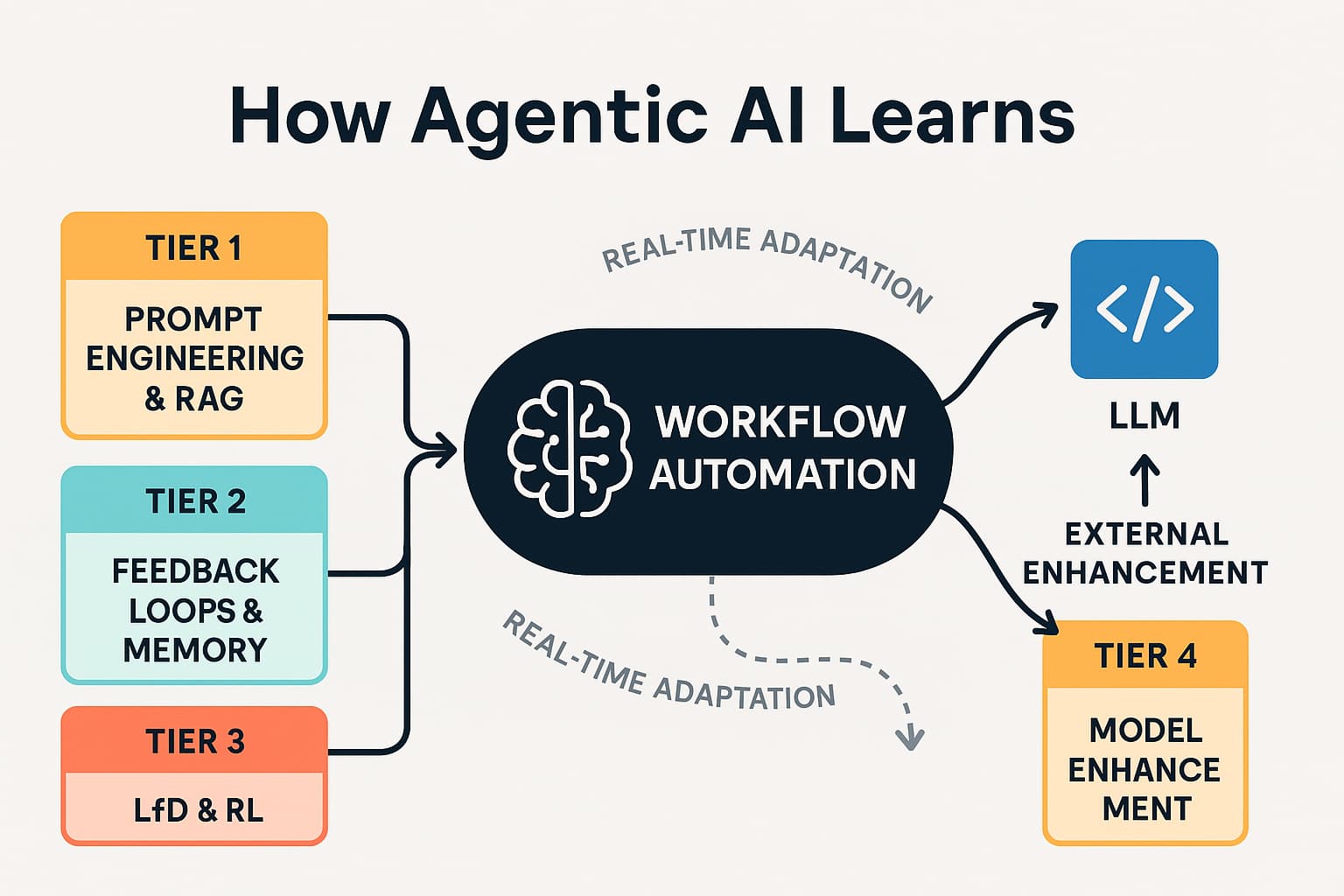
In today’s fast-paced business environment, enterprises need systems that can adapt, learn, and improve over time. Continuous learning is no longer optional—it is essential for staying competitive. Agentic AI services plays a critical role in enabling continuous learning systems by combining autonomous decision-making, memory retention, feedback loops, and adaptive reasoning. Unlike static AI models that require retraining, agentic AI agents learn dynamically from interactions, outcomes, and evolving data streams.
The Need for Continuous Learning
Traditional AI systems are typically trained once and deployed as fixed models. Over time, performance may degrade as new data, market conditions, or workflows emerge. Continuous learning systems, on the other hand, allow agents to incorporate new information, update strategies, and improve predictions in real time.
Enterprises that adopt continuous learning AI gain flexibility, adaptability, and resilience. In industries like finance, healthcare, manufacturing, and retail, the ability to evolve with changing data is a key competitive advantage.
Memory and Feedback as the Foundation
Agentic AI relies heavily on memory and feedback loops to support continuous learning. Memory structures retain past interactions, task outcomes, and performance metrics. Feedback mechanisms evaluate success against predefined goals, identify errors, and guide corrective action.
For example, an AI agent managing customer support tickets can track which solutions resolved issues most effectively and adjust its responses in future interactions. Over time, the system becomes more accurate, efficient, and aligned with business objectives.
Adaptive Decision-Making
Continuous learning systems must be capable of adjusting decisions based on new evidence. Agentic AI agents constantly monitor outcomes, analyze deviations, and modify strategies.
In supply chain management, for instance, an agent can adapt delivery schedules based on traffic data, weather conditions, or supplier delays. Adaptive decision-making reduces operational risks and ensures more reliable outcomes.
Real-Time Model Updates
Unlike traditional AI retraining cycles that occur periodically, agentic AI supports real-time model updates. Agents can integrate streaming data, learn from user interactions, and refine predictive algorithms on the fly.
This real-time adaptability ensures that systems remain effective even in dynamic environments, where rapid changes can render static models obsolete.
Human-in-the-Loop Collaboration
While agentic AI can autonomously learn, human oversight enhances continuous learning systems. Humans provide strategic guidance, validate high-impact decisions, and correct errors.
By combining human judgment with agentic AI’s learning capabilities, enterprises achieve faster adaptation, greater reliability, and improved compliance.
Scaling Continuous Learning Across Enterprises
Agentic AI allows continuous learning systems to scale across departments and regions. Agents operating in different business units can share insights, synchronize knowledge, and coordinate strategies.
For example, a marketing agent in one region can learn which campaigns resonate with customers and share patterns with agents in other regions, improving overall performance while maintaining contextual relevance.
Benefits of Continuous Learning Agentic AI
Improved Accuracy: Agents refine decisions and predictions over time.
Operational Efficiency: Automation combined with learning reduces repetitive errors and manual intervention.
Strategic Agility: Enterprises can respond quickly to market changes, customer behavior shifts, and operational anomalies.
Employee Empowerment: Human teams focus on strategy and oversight rather than repetitive monitoring and problem-solving.
Challenges and Considerations
Implementing continuous learning systems requires addressing challenges such as data quality, privacy compliance, and model drift. Agents must differentiate between noise and meaningful signals, prioritize learning from relevant outcomes, and avoid reinforcing biases. Strong governance, monitoring, and auditing frameworks are essential to maintain trust and reliability.
The Future of Continuous Learning
As agentic AI evolves, continuous learning systems will become more proactive and predictive. Agents will anticipate trends, simulate outcomes, and optimize strategies before interventions are required. Enterprises will benefit from increasingly autonomous, adaptive, and intelligent operational networks.
Final Thoughts
Agentic AI transforms continuous learning from a theoretical concept into actionable enterprise capability. By embedding memory, feedback loops, and adaptive reasoning, organizations can deploy systems that learn and evolve continuously.
The result is a smarter, more resilient enterprise capable of responding to dynamic conditions, optimizing performance, and sustaining competitive advantage.
