

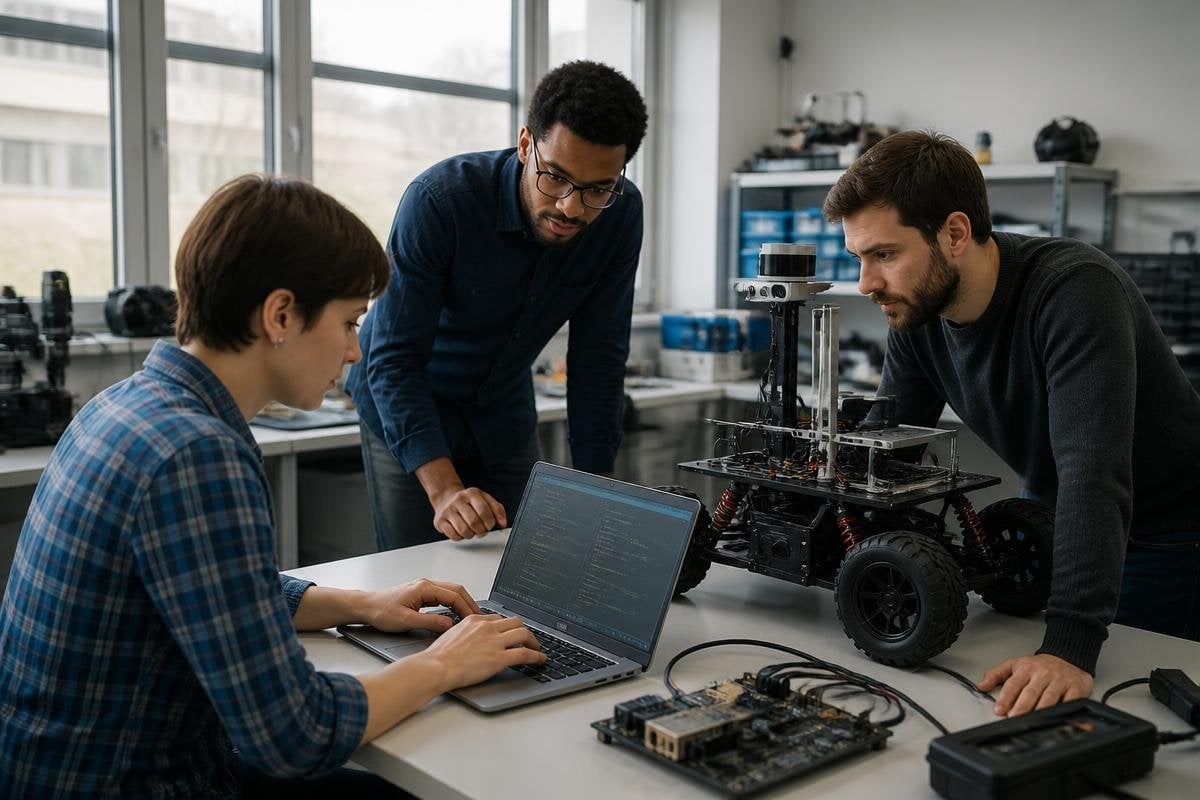
A robotics team can start with tested software instead of writing every driver, tool, and control layer from the ground up. That shared base shortens early work, lets engineers compare results, and leaves more time for the parts that make one robot different from another.
Quick read
- Shared code for sensors, motors, maps, and robot control
- Faster trials with ROS 2, Gazebo, Linux, Python, and C++
- Real limits around support, safety, testing, and long-term maintenance
The shared software base
Robots need many software parts to work together. A camera sends images, a LiDAR sensor measures distance, a motor controller moves a joint, and a planning system chooses the next motion.
Open source projects can give a team common tools for linking those parts.
ROS 2 is one example. It gives developers a way to split robot software into separate nodes, which are small programs with defined jobs. One node can read a camera while another builds a map, and a third sends movement commands.
That structure matters when the robot changes. A team can replace a camera or motor controller without rewriting the whole system, provided the new part uses the same software interfaces. The work still needs testing, but the starting point is clearer.
Why development can move faster
With shared code, engineers can study working examples before they write their own. A developer can inspect how a sensor driver handles data, run a simulation, then change the code for a specific robot.
Simulation tools such as Gazebo can test movement and sensor data without putting hardware at risk. Linux gives robotics teams a common operating system, while Python and C++ cover many tasks from quick scripts to low-level motor control.
The gain comes from reuse. A team can spend its time tuning a gripper, planning a warehouse route, or checking how a robot behaves near people instead of rebuilding basic communication tools.
Shared code can shorten the build, but it doesn’t prove the robot works outside a lab. Robot24.com robotics reporting links open source tools to named machines, companies, and automation projects, so you can see where the software has been tested and what still needs human work.
The work that open source does not remove
Shared code doesn’t make a robot safe by itself. Engineers still need to check sensor errors, motor limits, network delays, and what happens when a part stops sending data.
A program that works in simulation can fail on a real floor. Wheels slip, lighting changes, cables loosen, and people move in ways a test model may not cover. The team needs hardware tests that match the place where the robot will run.
Support is another concern. An open project may have clear documentation and active maintainers, or it may depend on code that has seen little recent work. A company building a product needs to check licenses, security fixes, release habits, and who will repair a fault later.
I think open source software is most useful when a team treats it as a starting point, not a finished robot.
How to judge a project before using it
A short check can prevent a software choice from causing trouble later:
- Check the license: confirm that its rules fit your product, customer, and shipping plans.
- Read the release history: look for recent updates, clear version names, and notes about changes.
- Run a small test: connect one sensor or motor before adding the project to the full robot.
- Inspect failure handling: see what the software does after lost data, a stopped node, or a bad sensor reading.
- Plan an owner: name the person or team who will update, test, and fix the code.
These checks turn reuse into a manageable engineering choice. They also show where a team may need its own code, especially around safety limits and hardware-specific control.
Open source software will keep its strongest effect in the parts of robotics that benefit from shared interfaces and repeatable tests. The next question for each team is practical: which part of the robot can use existing code, and which part needs proof on the real machine?
